
Status of Muslim Women in India
THE VYNO LEGAL BULLETINS
Nandhini
1/4/20249 min read
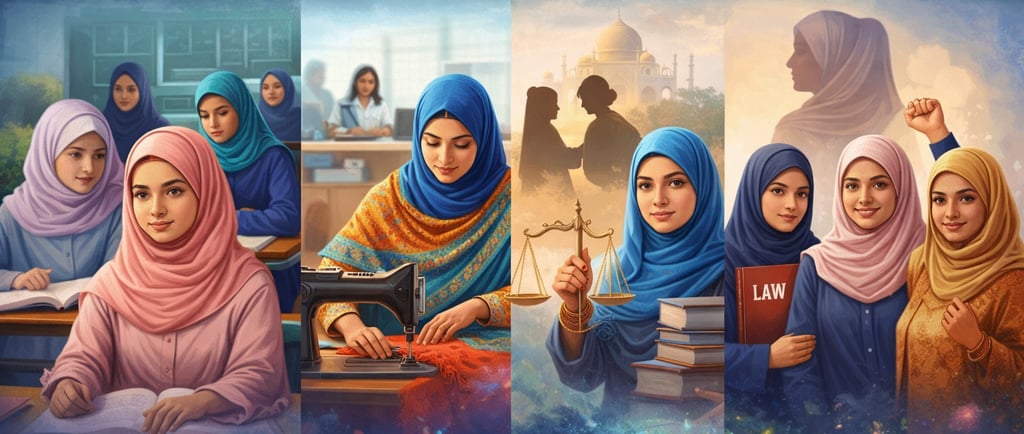
ABSTRACT:
This article explores into the Status of ‘Muslim Women’ in India, in the light of Law’s made to Empower them. At 120 million strong, Muslim community constitute 12% of the population of India. The relative backwardness of Muslim community and particularly of Muslim women, is noted as a factor in the comparatively high fertility rates observed among the Muslim population. This article concludes by apprising the rights and by emphasizing the positive role played by laws and personal law to enhance the condition of Muslim women in India.
INDIA:
India is a secular, diverse and a sovereign nation; it welcomes people from throughout the world venerating any religion and treats everybody with equality. Neither religion is above anyone in India. Indian citizens always have the right to equality and justice since India is a Socialist, Secular, Democratic and Republic country. And Constitution under Article 25 to 28 protects the same by ensuring the practice in real life.
MUSLIMS: (In India)
Indian Muslim population is 3rd largest and the biggest Minority population of the world and principal Minority of India. Orthodox Muslim uphold the low position of women as a symbol of cultural identity. They occupy an important position in the Indian society. Out of the total number of Muslims throughout the world, Muslim in India constitutes is 10.3% which is Approx.195,000,000 people as in year 2022.
INTRODUCTION:
Not a single day go spare, of news about Muslim women rights violation. The Rate of Women Empowerment is in an impuissant condition and is a contemporary issue within the Largest Muslim Minority in an emerging country like India. Though women and men rule over innumerable individuals together today, yet this is not spread through all the webs of the world. Equality and justice have consistently been engirdled by the issues and convened by law.
A crucial issue being faced by them is Lack of social opportunities. It is weened that Muslim woman is forced yet to live a concealed and a submissive life. And development of Muslim society has experienced a hitch due to numerous factors of which the ‘Invisible' role and 'Marginal' social position of Muslim women is very essential. The action of gender discrimination begins even before the birth and it continues throughout the life of a women. And there is some misconception about the term equality between the Muslim men and women. According to the Sachar Committee report, ‘Muslim women are amongst the poorest, educationally disenfranchised, economically vulnerable, politically marginalized group in the country’.
‘Muslim women are minorities in the minority’.
MUSLIM WOMEN IN EDUCATIONAL INSTITUTIONS:
A report from the National Statistical Office points out that Muslims have the highest of youth population of ages 3-35 years, who have never enrolled in formal education. This Report reveals the severity of their academic marginalization in India and states the Gross Attendance Ratio of Muslims is100 percent in primary education and drops to14, meagre percent in higher secondary education courses.
MUSLIM WOMEN IN INDIA’S WORK FORCE:
There are approximately 70 million educated Muslim women in the country. And yet they are practically invisible in the country’s workforce. India’s female Labor Force Participation Rate (LFPR) is dropping down. According to a study, participation of educated Muslim women in the country’s workforce could, account for approx. 77,000 billion crores of the country’s GDP. The lack of women leaders is even dreary. Woefully, Indian Muslim women face the double disadvantage of being female and Muslim.
MUSLIM PERSONAL LAW:
In India, Muslims are governed by Muslim personal laws, Shariat law. These personal laws can be found only in primary source of law since most of them are uncodified laws. Muslim personal laws were always been a sensitive subject, and a subject of controversy, debate, and a political issue. Though Muslim personal laws in India have never been systematically codified, but the execution of a new law is a step fortifying ‘Gender equality and Invigorate Fundamental, Democratic, Constitutional rights of the Muslim women’. These personal laws have both positive and negative aspects.
Withal to boot, the Supreme Court of India has declared the applicability of the Secular law on to Muslims in Shah Bano's case.
l Right of maintenance, for the Iddat period after the divorce.
Indian Judiciary with change gives such landmark judgment, whereby protecting the Rights of Muslim women: -
THE MUSLIM WOMEN (PROTECTION OF RIGHTS AND MARRIAGE) ACT, 2019:
We have witnessed Triple Talaq among Muslims which sequels a deep backlash.
Hence,
l Section 3 of this act says the ‘Talaq to be Void and Illegal’.
l Section 4 of this act specifies the ‘Punishment for pronouncing Talaq’.
The lives of girls and women continue to be controlled by the patriarchal belief systems where men take all decisions for women. Men are active and Women are passive parts of the society. Without prejudice to the generality of the provisions contained in any other law for the time being in force;
l Section 5 of this act provides ‘Subsistence allowance’ for women and children.
l Section 6 of this act provides ‘Custody of minor children’.
‘Married Muslim women will be given first preference than Muslim men for the custody of their child’.
Talaq to be Void and Illegal: (Section 3)
l ‘Any pronouncement of talaq by a Muslim husband upon his wife, by words, either spoken or written or in electronic form or in any other manner whatsoever, shall be void and illegal’.
Punishment for pronouncing Talaq: (Section 4)
l ‘Any Muslim husband who pronounces talaq referred to in section 3 upon his wife shall be punished with imprisonment for a term which may extend to three years, and shall also be liable to fine’.
Subsistence allowance: (Section 5)
l A married Muslim woman upon whom talaq is pronounced shall be entitled to receive from her husband such amount of subsistence allowance, for her and dependent children, as may be determined by the Magistrate’.
Custody of minor children: (Section 6)
l ‘A married Muslim woman shall be entitled to custody of her minor children in the event of pronouncement of talaq by her husband, in such manner as may be determined by the Magistrate’.
The verity that the Hon'ble Supreme Court of India has determined to acknowledge and concede the rights of those who truly deserve it, is a positive step towards the injustice that Muslim women are subjected to, ‘is laudable’.
SHARIAT APPLICATION ACT, 1937 or PERSONAL LAW: -
1. MARRAIAGE AND DIVORCE RIGHTS OF MUSLIM WOMEN:
Nikah or Marriage is:
l Contract – under legal aspect.
l High status – under social aspect.
l Gift of Allah – under religious aspect.
The Quran’s depiction of man and woman in marriage:
“They are your apparels and you are their apparels”. This reflects the equality of men and women in Islam.
l Laws related to inheritance, marriage, custody and Adoption are based on mathematical fraction.
l And neither Men are superior to Women nor Women superior to Men.
a) Restricted Polygamy:-
Islamic laws are not restricted to strict monogamy, but a person has to treat all his wives equally with love and affection, which is impossible for a human. In India, a Muslim man cannot marry more than four women. If a man wants to marry fifth wife, in that case he has to divorce one amongst four existing wives, if not; that marriage will be considered voidable.
b) Age of Puberty:-
In case the girl married during minority, she is entitled to a dissolution of her marriage before attaining the age of 18 years.
c) Right to get Maher:-
Maher is the requisite condition to the marriage; it is a token of admiration. It is foremost right of woman who is getting married, symbolizing her husband’s honesty and love for her. Maher can be either wealth or any other thing having value. If it is not specified in marriage terms, such marriage is considered void.
d) Divorce rights:-
“Where there is a valid wedlock, the right of divorce exists parallel”.
This is a significant feature of marital rights. A Muslim wife cannot divorce her husband of her own accord. She can divorce the husband only when the husband has delegated such a right to her, or under any agreement.
Divorce by joint consent, two forms are:-
l Khula – meaning release.
l Mubarat – meaning mutual separation.
2. PROPERTY RIGHTS OF MUSLIM WOMEN:
The Islamic laws have accepted Muslim women as a free and responsible member, and they hold an expedient position in society.
a) Property rights of Muslim a daughter:-
Daughters have right and may acquire property by the wills but it mustn’t exceed 1/3rd of the total property of the person who made the will. And they have rights of maintenance and residence in parent’s house, until their marriage.
b) Property rights of Muslim Wife:-
By virtue of marriage, Islamic law provides financial security to a Muslim woman. When there are no heirs in estate as prescribed by the law, she may acquire higher will. At the time of marriage, a Muslim wife is entitled to receive total money or Dower (Maher) from her husband.
c) Property rights of Muslim Widow:-
In Islamic law, a Muslim widow gets -
● 1/8th share - if they have children.
● 1/4th share - if they don’t have children.
● 1/16th share – in case of more than one wife.
Of her husband’s property.
3. MAINTENANCE RIGHT OF DIVORCED WOMEN:
THE MUSLIM WOMEN [PROTECTION OF RIGHT ON DIVORCE ACT, 1986] -
Reasonable and fair maintenance to be paid to his wife within the iddat period by former husband. And Muslim widow has no right of maintenance than her husband’s estate, inheritance as his wife. A Muslim father has a personal but not absolute obligation to maintain his children. And he is bound to maintain his female children until her/their marriage.
PROBLEMS FACED BY MUSLIM WOMEN:
l Because of religious affiliation, many Muslim women are facing discrimination in their schooling and are less likely to enroll in schools compared to Muslim men. We live in a Country that believes in Equality but sometime the term “equality” seems to be vague as very few rules, regulations and laws came into existence. Half of the women population are still unaware of their rights and duties. And they still believe in orthodox custom which inflicts upon them that the man is superior to women.
l A “right life” is achieved at the point at which one has rights throughout his life. Each human is brought into the world free; liberated from duties, allowed to pick their method of living.
l But still personal law is prevailing and violating the constitutional injunctions. These problems faced by Muslim women enforces certain stereotypes and act as roadblocks for the community and leads to discrimination.
CONCLUSION:
l The Status of women in different human societies of the world is different. It may be either developed, developing country. Muslims occupy an important position in Indian society. One right step to develop Muslim religion would be to expand the scope of the Right to Education Act of 2009, that ensures compulsory primary, secondary and higher education.
l In this 21st Century, Muslim women are still fighting for their rights. This is the high time to implement Article 44 (Uniform Civil Code) in India instead of regulating uncodified laws according to one’s religion.
l Both state and fundamentalists are needed to wake up and put robust efforts to bring Muslim women in mainstream by implementing the laws and schemes framed for them by Indian judiciary in a appropriate way.
REFERENCE:
1. Aditee Arya. 2021. Rights of Muslim women in India. iPleaders. [Online]. Available https://blog.ipleaders.in/rights-muslim-women-india/ . (Last visited March 1, 2022).
2. Ministers/Departments in the Government of India. 2019. The Muslim Women (Protection of Rights on Marriage) Act, 2019. INDIA CODE Digital Repository of All Central and State Acts. [Online]. Available https://www.indiacode.nic.in/handle/123456789/11564?locale=en . (Last visited March 1, 2022).
3. Priyanka Kumawat. and Sapna Maurya. 2021. Rights of Muslim Women in India. International Journal of Law Management and Humanities. [Online]. Available https://www.ijlmh.com/rights-of-muslim-women-in-india/ . (Last visited March 1, 2022).
4. Ritika Sahu. 2018. Rights of Muslim Women-An Analysis Under Personal Law. Legal Service India E-Journal. [Online]. Available https://www.legalserviceindia.com/legal/article-234-rights-of-muslim-women-an-analysis-under-personal-law.html . (Last visited March 1, 2022).
5. Z Bhatty. 1994. Socio-economic status of Muslim women. National Center for Biotechnology Information. [Online].
Available:https://pubmed.ncbi.nlm.nih.gov/12347368/#:~:text=Although%20Indian%20women%20live%20under,adjustment%2C%20change%2C%20and%20accommodation . (Last visited March 1, 2022).
6. Ramphul Ohlan. 2020. Muslim Women in India: Status of Demographic, Socioeconomic and Health Inequalities. Taylor & Francis. [Online]. Available https://www.tandfonline.com/doi/abs/10.1080/13602004.2020.1813991?journalCode=cjmm20 . (Last visited March 1, 2022).
7. Malika B Mistry. 2006. Muslims in India: A demographic and socio-economic profile. Taylor & Francis. [Online]. Available https://www.tandfonline.com/doi/full/10.1080/13602000500408468?src=recsys (Last visited March 1, 2022).
8. Syed Shahabuddin. 2007. Economic status of the Muslim community in India: an overview. Taylor & Francis. [Online]. Available https://www.tandfonline.com/doi/abs/10.1080/02666958408715896?src=recsys . (Last visited March 1, 2022).
9. Raghuraj Gupta. 2007. Changing role and status of the Muslim minority in India: a point of view. Taylor & Francis. [Online]. Available https://www.tandfonline.com/doi/abs/10.1080/02666958408715891?src=recsys (Last visited March 1, 2022).
10. Sanu. and Md Sahnewaz. 2018. Empowerment of Muslim Women in India: A Study of Socio-Economic and Political Disparities. Munich Personal RePEc Archive. [Online]. Available https://mpra.ub.uni-muenchen.de/107878/ (Last visited March 1, 2022).
11. Deepanjali Lahari. and Dr. Ruha Shadab. 2021. Muslim women in India’s workforce: Where are they?. India Development Review (IDR). [Online]. Available https://idronline.org/article/diversity-inclusion/muslim-women-in-indias-workforce-where-are-they/ (Last visited March 1, 2022).
12. Saumya Verma. 2019. Muslim Women in India: A Struggle for Dignified Existence. Advocate, Madhya Pradesh High Court. Amity International Journal of Judicial Sciences. Available https://www.ijlmh.com/rights-of-muslim-women-in-india/ (Last visited March 1, 2022).