A Law, a Ban, and a Reality: What Prohibition in Bihar Tells Us | Advocate Himanshu Ranjan
THE VYNO LEGAL BULLETINS
Advocate Himanshu Ranjan
4/3/20264 min read
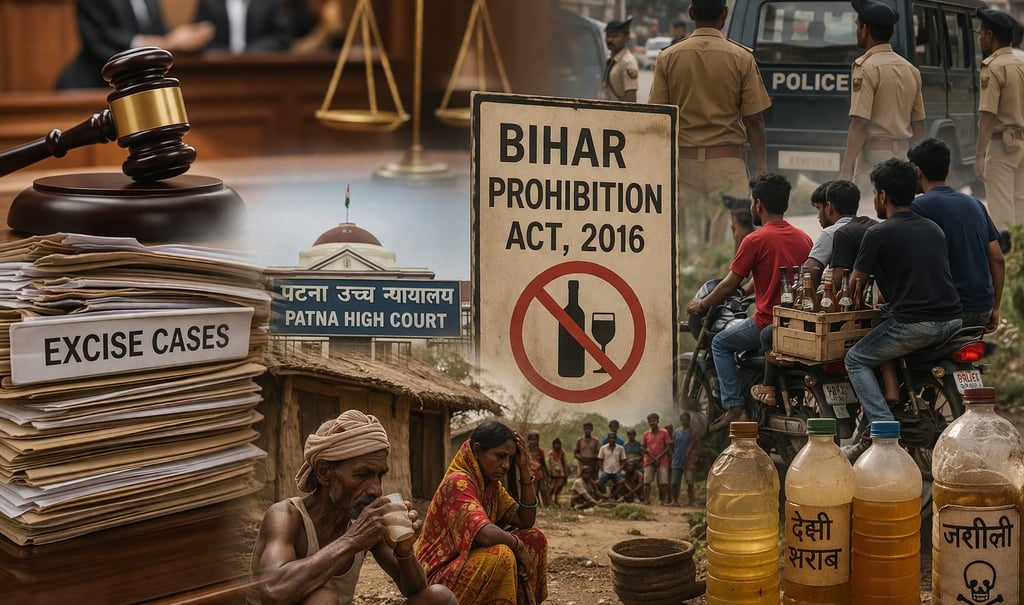
Bihar is officially a dry State. On paper, alcohol is banned, and the law promises a cleaner and more disciplined society. The intention behind prohibition is understandable. It aims to reduce addiction, protect families, and bring a sense of order to everyday life. In many homes, especially in rural areas, this change has been felt. There is no doubt that incidents of open drinking, public nuisance, and drink and drive cases have reduced. In several households, women have experienced a certain level of relief. Domestic disturbances linked to alcohol consumption have, to some extent, come down. These are real gains, and they should not be ignored.
At the same time, it has now been nearly a decade since the Bihar Prohibition and Excise Act, 2016 came into force. This passage of time makes it necessary to look at the law not just from the point of view of intention, but from the reality of its implementation. The question today is not why prohibition was introduced, but whether it is working in the way it was expected to.
From a courtroom perspective, the impact is immediate and visible. A large number of cases listed every day are related to excise offences. Special courts have been created to deal with these matters, which itself shows the scale of litigation. Judicial time, which is already limited, is now heavily occupied with prohibition-related cases. Many of the accused are not serious offenders. They are daily wage earners, small workers, or individuals caught with minimal quantities. The system is processing them in large numbers, and in doing so, valuable judicial attention is diverted from more serious crimes. This raises a practical concern about whether the criminal justice system is being used in the most effective manner.
The pressure is equally visible on the policing system. Police personnel are continuously engaged in raids, seizures, and arrests related to prohibition. This requires time, manpower, and administrative effort. In a State where resources are already stretched, such heavy engagement naturally affects other areas of policing. It becomes important to ask whether this allocation of resources is balanced, and whether more serious law and order concerns are receiving adequate attention.
There is also an economic side to this issue which is often discussed less openly. Before the ban, the State earned significant revenue from excise duty, estimated to be around ₹4000 crore annually. After prohibition, this source of income effectively came to an end. However, the financial needs of governance did not reduce. The gap has to be filled through other means, and over time, there has been an increased burden through other channels such as transport taxes, registration charges, and adjustments in land valuation. The revenue does not disappear, it shifts, and in many cases, it indirectly reaches the common public.
Perhaps the most important aspect is the ground reality. Despite a complete ban, liquor remains accessible in many parts of the State. This is not merely an assumption but something reflected in the number of cases and everyday experience. If alcohol were truly unavailable, such widespread enforcement would not be necessary. The presence of cases itself indicates the presence of supply. This leads to a deeper concern about how liquor continues to enter the State and how supply networks are functioning.
The situation becomes more serious when we look at what people are actually consuming. Branded or relatively safer alcohol is still accessible in the State, but it is expensive and not within the reach of economically weaker sections. As a result, many poorer individuals turn to cheaper alternatives in the form of illicit or spurious liquor. In many villages, people consume locally made alcohol that is unregulated and often toxic. We have witnessed multiple incidents in the past where many people have lost their lives due to such poisonous liquor. This shows that prohibition has not eliminated drinking, but has pushed a section of society towards more dangerous options.
At the same time, there is a social dimension that requires careful balance. It is true that after the ban, open drinking in public places has significantly reduced. Incidents of public nuisance have gone down. Many families, particularly women, have experienced a certain level of stability in their homes. This is an important achievement and must be acknowledged honestly. Any future policy must ensure that these gains are not reversed.
However, there is another side which is gradually emerging. Young individuals, particularly in rural and semi urban areas, are getting involved in the illegal sale of liquor. The reason is simple, it offers quick money. This raises a serious concern about how their futures are being affected. What begins as small involvement can slowly draw them into larger illegal networks. Instead of creating a disciplined society, there is a risk of creating informal criminal chains at the local level.
All of this leads to a broader question. The issue is not whether prohibition as an idea is right or wrong. The intention behind it is clearly rooted in social welfare. The real issue lies in its execution. A law of this nature requires very strong and effective enforcement at the level of supply chains. If liquor is still easily available, it means the larger networks are not being effectively controlled. Focusing only on consumers while supply continues does not solve the problem.
Going forward, the State may need to take a more practical view. One approach is to make enforcement much stricter and more targeted, ensuring that the State genuinely becomes a dry State in reality and not just in law. This would require strong action against supply networks and consistent monitoring. The other approach could be to consider a regulated system with strict rules, where sale is allowed only through licensed vendors, with proper identity checks, quantity restrictions, and clear safeguards to prevent misuse. Any such system must be designed in a way that continues to protect families, particularly women, and ensures that issues like domestic violence and public disorder do not increase again.
What is important is that the policy must match the reality on the ground. A law that exists only on paper but does not fully operate in society creates pressure on institutions without achieving its complete purpose.
After nearly a decade, Bihar stands at a point where it needs to reflect honestly on its experience with prohibition. The intention was strong, and in many ways, it has achieved certain social benefits. But at the same time, the challenges in implementation, the burden on courts and police, the economic adjustments, the rise of illicit liquor, and the changing social patterns cannot be ignored.
A good law is not only about its objective. It is also about how effectively it works in practice. If the gap between law and reality continues to exist, then it becomes necessary not to abandon the idea, but to improve the way it is implemented.
Author: Himanshu Ranjan, Advocate practicing before the Hon’ble Patna High Court.